Best Wheelchairs for Senior Corgis with DM
Best wheelchairs for Corgis with degenerative myelopathy. Rear-wheel carts, drag bags, and mobility aids sized for Pembroke Welsh Corgis.
If your Corgi has been diagnosed with degenerative myelopathy, you're facing one of the most emotionally challenging journeys in dog ownership. DM is a progressive, incurable spinal cord disease — and Pembroke Welsh Corgis are one of the breeds most commonly affected, with an estimated 50% carrying the genetic mutation. The good news? A properly fitted wheelchair can give your Corgi months or even years of active, joyful life after their hind legs give out.
We've researched the best wheelchair options specifically for Corgis — a breed with unique sizing challenges due to their long body, short legs, and substantial weight (25-30 lbs). These aren't one-size-fits-all carts; they're precision-fitted mobility devices that restore your Corgi's independence.
Best Wheelchairs & Mobility Aids for Corgis — Our Top Picks

Ceva Walkin' Wheels Rear Dog Wheelchair (Small)
The industry standard. Fully adjustable, fits Corgis perfectly. Lightweight aluminum frame with padded straps.

PICK FOR LIFE K9 Carts Original Rear Support Wheelchair
Custom-built to your Corgi's exact measurements. Premium construction with marine-grade hardware.

Walkin' Wheels Walkin' Drag Bag for Dogs
Protects belly and hind end when wheelchair is off. Durable nylon with fleece lining. Essential for indoor use.

DOK Ultra Paws Durable Dog Boots (Petite)
Rear paw protection for Corgis with knuckling. Prevents toe drag injuries. Rugged sole with secure fit.
Understanding DM in Corgis
Degenerative myelopathy attacks the white matter of the spinal cord, progressively destroying the nerve fibers that carry movement signals from the brain to the hind legs. In Corgis, the disease typically follows this timeline:
Stages of DM
- Early (months 1-6): Subtle hind-end wobbling, occasional rear-foot knuckling, difficulty on slippery floors. A support harness is usually sufficient at this stage.
- Mid (months 6-12): Increasing hind-leg weakness, crossing of back legs, dragging rear feet, difficulty standing without help. A rear-support wheelchair becomes necessary for walks.
- Late (months 12-18): Complete hind-leg paralysis, loss of bladder/bowel control, possible front-leg involvement. Full-time wheelchair use for outdoor mobility, drag bag for indoor movement.
- Advanced (months 18+): Potential front-leg weakness requiring a full-support (quad) wheelchair. Quality of life assessment becomes critical at this stage.
Important: These timelines are averages. Some Corgis progress faster, others slower. DM is not painful in itself, which means many DM Corgis maintain excellent quality of life with proper support.

Best Overall: Walkin' Wheels Rear Wheelchair
The Walkin' Wheels is the most widely used and veterinarian-recommended dog wheelchair on the market, and it's our top pick for Corgis with DM. Its key advantage is full adjustability — the same chair can be adjusted as your Corgi's condition changes, potentially lasting through the entire progression of DM.
Why It Works for Corgis
- Adjustable height: Accommodates the Corgi's uniquely short legs (wheel height adjusts from 5-11" in the small size)
- Adjustable width: Fits the Corgi's stocky body (hip width adjusts 5-8")
- Adjustable length: Accommodates the Corgi's long body relative to their height
- Lightweight aluminum frame: Only 4-5 lbs — won't weigh down your 25-30 lb Corgi
- Padded neoprene straps: Comfortable for extended use, won't rub or chafe
- Easy on/off: Front leg openings make attachment quick — important for daily wheelchair use
The Small size fits most Pembroke Welsh Corgis. Measure your Corgi's hind leg height (ground to hip joint), hip width, and body length before ordering. Walkin' Pets provides detailed measurement instructions and a video guide on their website.
Price range: $300-$400 for the Small rear-wheel model.
How to Measure Your Corgi for a Wheelchair
- Hind leg height: Measure from ground to hip joint while standing (support the rear if needed). Typical Corgi: 8-10 inches.
- Hip width: Measure across the widest point of the hips. Typical Corgi: 5-7 inches.
- Body length: Measure from the base of the tail to behind the front legs. Typical Corgi: 15-19 inches.
- Weight: Confirm current weight — most Corgis fit the Small wheelchair (11-25 lbs) or Small/Medium (20-40 lbs).
Best Custom-Fit: K9 Carts
For Corgis with unusual proportions or those who need a precisely custom fit, K9 Carts builds each wheelchair to your dog's exact measurements. You submit detailed measurements and photos, and they construct a cart specifically for your Corgi's body.
The advantage of a custom build is perfect fit from day one — no adjustment period, no gaps or pressure points. The marine-grade stainless steel hardware is more durable than standard aluminum, and the construction quality is exceptional.
The drawback is that custom carts can't be adjusted if your Corgi's body changes (weight gain or loss, muscle wasting from DM progression). They're also more expensive and have a 2-4 week build time.
Price range: $350-$600 depending on customization and accessories.
For Different DM Stages
Ceva Walkin' Wheels Full Support (Quad) Wheelchair
For advanced DM with front-leg involvement. Supports all four legs. Same adjustability as rear model.
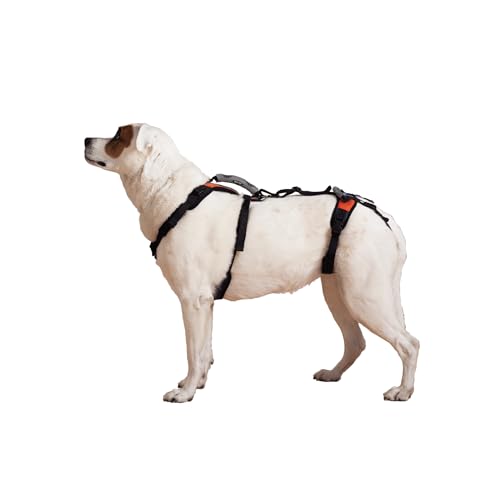
Help 'Em Up Help 'Em Up Harness (Medium)
Full-body support harness for early-stage DM before a wheelchair is needed. Can be used alongside a wheelchair.
Essential Companion Products
Drag Bags
When the wheelchair is off (during rest, indoor time, bathroom breaks), your paralyzed Corgi will move around by dragging their hind end. Without protection, this quickly causes skin abrasions, infections, and calluses on the belly, knees, and hind legs. A drag bag is essential.
The Walkin' Drag Bag wraps around your Corgi's hind end with a durable nylon exterior and soft fleece lining. It protects the skin while allowing bathroom access. Machine-washable for easy cleaning.
Price range: $30-$50.
Protective Boots
In early and mid-stage DM, your Corgi may drag their hind toes while walking (knuckling). This wears through the top of the paw rapidly, causing painful raw spots. Rear paw boots protect the toes from drag abrasion. Look for boots with reinforced toe caps and secure fastening.
Price range: $20-$40 for a set of two rear boots.
Indoor Traction
Corgis with DM struggle terribly on smooth floors. Hardwood, tile, and laminate become ice rinks for their weakened hind legs. Solutions include:
- Yoga mats or carpet runners: Lay down traction pathways through your home ($10-$30)
- Dr. Buzby's ToeGrips: Rubber rings that fit over toenails for instant traction ($15-$25)
- Non-slip socks: Rubber-soled socks for indoor use ($10-$20)

Indoor Mobility & Hygiene Essentials

Dr. Buzby's Dr. Buzby's ToeGrips for Dogs (Small)
Rubber toenail grips for instant traction on smooth floors. Non-invasive and easy to apply.

Eterish Washable Pee Pads (Reusable, XL)
For Corgis with incontinence from DM. Washable saves money over disposables. Waterproof backing.
Helping Your Corgi Adjust to a Wheelchair
- Start on a flat, smooth surface like a quiet sidewalk or driveway — not grass, which adds resistance.
- Use treats and excitement. Most Corgis are food-motivated — hold treats ahead of them to encourage forward movement.
- Keep sessions short at first: 5-10 minutes, building to 15-30 minutes over the first week.
- Check for rubbing after each session. Look for red spots, raw areas, or hair loss at strap contact points.
- Stay with them. Until your Corgi is confident, supervise all wheelchair time to prevent tipping or getting stuck.
- Be patient. Some Corgis walk confidently within minutes; others need several sessions over a week to adjust.
Quality of Life with DM
DM is a devastating diagnosis, but it doesn't mean your Corgi's happy days are over. With proper support — wheelchairs, drag bags, incontinence management, and physical therapy — many DM Corgis enjoy excellent quality of life for 12-18+ months after diagnosis. The breed's natural determination and joy make them some of the best wheelchair candidates in the dog world.
Regular quality-of-life assessments with your veterinarian help ensure your Corgi remains comfortable and engaged. The Lap of Love Quality of Life Scale and the HHHHHMM scale are useful tools for ongoing evaluation.
For more mobility solutions, visit our mobility aids section. Learn about support harnesses in our buyer's guides, and explore comprehensive care strategies in our comfort and pain management section.
Wheelchair & Mobility Essentials for Senior Corgis
- Adjustable Dog Wheelchairs — Rear-support carts for Corgis with degenerative myelopathy
- Drag Bags for Dogs — Protect paws and belly when not in the wheelchair
- Washable Dog Diapers — Incontinence management for DM-affected Corgis
Pet Insurance · Sponsored
Protect Your Senior Dog From Surprise Vet Bills
Senior dogs are more likely to face arthritis, lumps, dental disease, and sudden emergencies, and a single visit can run into the hundreds or thousands. Pet insurance can help you say yes to the care your dog needs without draining your savings. Get a free quote and see what coverage fits.
Frequently Asked Questions
How common is DM in Corgis?
Degenerative myelopathy (DM) is extremely common in Pembroke Welsh Corgis — the breed has one of the highest carrier rates for the SOD1 gene mutation that causes DM. Studies suggest that up to 50% of Pembroke Welsh Corgis carry at least one copy of the mutation, and dogs with two copies are at high risk for developing the disease.
When does my Corgi need a wheelchair?
A wheelchair is typically needed when your Corgi can no longer support their own weight on their hind legs for walking, even with harness support. This usually occurs 6-12 months after the first symptoms of DM appear. Signs include: dragging hind feet, crossing back legs, inability to stand without assistance, and complete hind-leg paralysis.
Can a Corgi still be happy in a wheelchair?
Absolutely. Most Corgis adapt to wheelchairs remarkably quickly — often within days. They're an energetic, determined breed, and a wheelchair restores their ability to walk, play, and explore. Many wheelchair Corgis run, play fetch, and show clear signs of joy and engagement with life.
What size wheelchair does a Corgi need?
Most Corgis (25-30 lbs) fit a Small or Small/Medium wheelchair. Critical measurements include: hind leg height from ground to hip joint (typically 8-10 inches for Corgis), width between hips (typically 5-7 inches), and body length from hip to shoulder. Always use the manufacturer's sizing chart with your specific measurements.
How long can a Corgi stay in a wheelchair?
Start with 15-30 minute sessions and gradually increase as your Corgi builds strength and comfort. Most adapted Corgis can use their wheelchair for 1-3 hours at a time. Always remove the wheelchair during rest, sleeping, and unsupervised periods. Watch for rubbing or skin irritation at contact points.
What's the difference between rear-wheel and full-support wheelchairs?
Rear-wheel wheelchairs support only the hind end, while full-support (quad) wheelchairs support both front and rear. For DM, which primarily affects the hind legs, a rear-wheel chair is usually sufficient in early to mid stages. If DM progresses to affect the front legs (which can happen in advanced cases), a full-support chair becomes necessary.
Do I need drag bags along with a wheelchair?
Drag bags (also called belly bands or scooters) protect your Corgi's hind end when they're out of the wheelchair and moving around indoors by dragging. They prevent skin abrasions on the belly, legs, and genitals. They're not a wheelchair replacement but an essential companion product for paralyzed Corgis.
Need more help with your aging dog?
Browse our guides by topic to find practical solutions.
Wellness Planner — $39